International expansion used to mean manual repetition.
If you wanted the same currency, theme, and pricing logic for France and Germany, you had to configure them twice. Multiply that by 10–20 countries, and global scaling quickly became fragile, time-consuming, and error-prone.
With the latest update, Shopify has quietly rewritten how international selling works.
Think of this as Shopify Markets 2.0:
a new structure built around Parent Markets, Submarkets, and unified Catalogs.
For many merchants, the transition is confusing.
For fast-growing brands, it’s a huge opportunity — if you understand the model.
The End of Manual International Scaling
Previously, Shopify Markets worked like a flat list:
- One country = one market
- Each market had its own currency, pricing, theme logic
- Changes had to be repeated country by country
This worked for a handful of regions, but it didn’t scale.
Now, Shopify introduces inheritance — allowing you to define shared rules once and reuse them across multiple regions.
The New Shopify Markets Hierarchy (Explained Simply)
The key concept to understand is Parent vs. Submarket.
Parent Market = The Template
A Parent Market acts as a shared configuration layer.
Example:
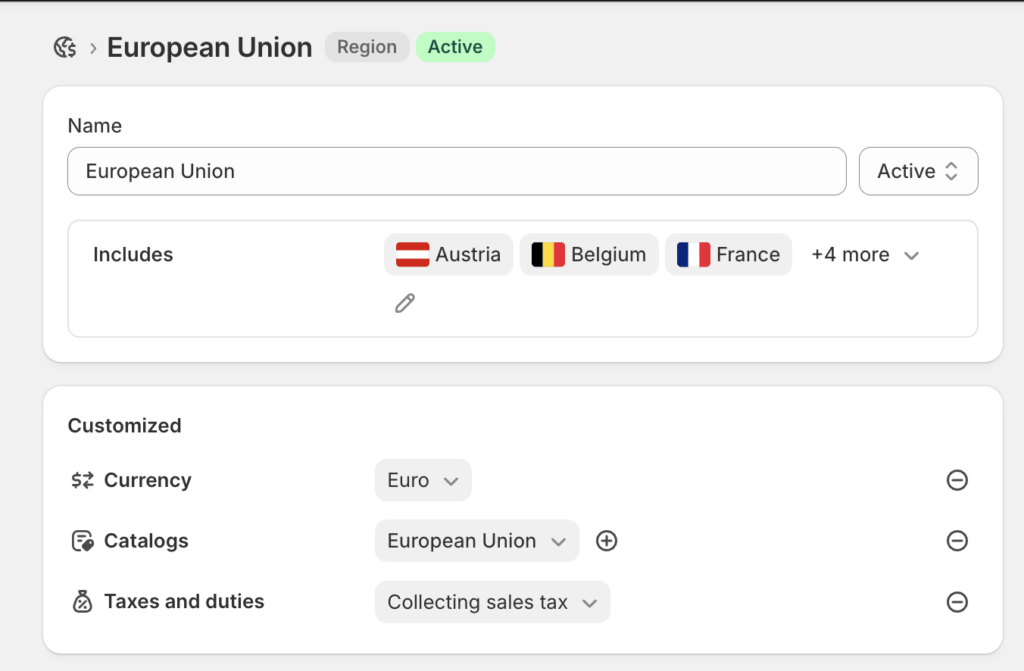
- Parent Market: European Union
- Currency: EUR
- Base theme
- Core pricing logic
- Default tax and duties behavior
You configure this once.
Submarket = The Local Variation
A Submarket inherits everything from its parent — unless you override it.
Example:
- Submarket: France
- Inherits EUR currency and EU theme
- Adds a France-specific catalog
- Shows a French-only promotion banner
- Uses localized content
Think of it like CSS inheritance:
- Parent = base styles
- Submarket = overrides where needed
This is the foundation that makes Shopify Markets finally scalable.
The Biggest Shift: Unified Catalogs
This is the most important — and most misunderstood — change.
Previously, Catalogs were mainly associated with B2B or Shopify Plus.
Now, catalogs are core to how Markets work.
What Catalogs Now Control
Catalogs determine:
- Which products are visible in a market
- Market-specific pricing
- Regional availability
This makes advanced use cases far easier.
Example: Regional Exclusives
- Product A: US-only
- Product B: EU + UK
- Product C: Germany-only launch
Instead of duplicating products or hacking collections, you simply assign different catalogs per market or submarket.
This shift alone removes a huge amount of technical debt for international stores.
What You Can (and Can’t) Do Per Shopify Plan
This is where expectations need to be set properly.
Starter / Basic Plans
- Can create markets and submarkets
- Limited theme and checkout customization
- Best for currency + basic localization
Advanced / Plus Plans
- Custom themes per market
- Deeper checkout customization
- More flexibility in pricing and catalog logic
Consultant Insight:
If you’re on Basic and feel constrained, that’s not you — it’s the plan.
True brand localization often requires Advanced to unlock the real power of Markets.
Scaling Markets Without Losing Your Mind
Once you move beyond a handful of regions, manual management becomes risky again.
Bulk Market & Catalog Management
Updating prices or availability across 20+ submarkets in the native UI is slow and error-prone.
That’s why I often use Matrixify to bulk-manage:
- Market pricing
- Catalog assignments
- Regional product visibility
It turns a multi-hour task into a controlled, auditable import.
Localization Requires Language
Markets define where you sell — language defines how you sell.
For proper localization, translation apps like Langify integrate cleanly with market-specific content and themes, without duplicating storefronts.
Why This Update Matters More Than It Looks
This isn’t just a UI change.
It signals a bigger shift:
- Shopify is standardizing global commerce architecture
- Markets are no longer isolated entities
- Clean hierarchy = fewer bugs, fewer workarounds, better scaling
Brands that design their Parent/Submarket structure correctly from day one will move faster and break less.